
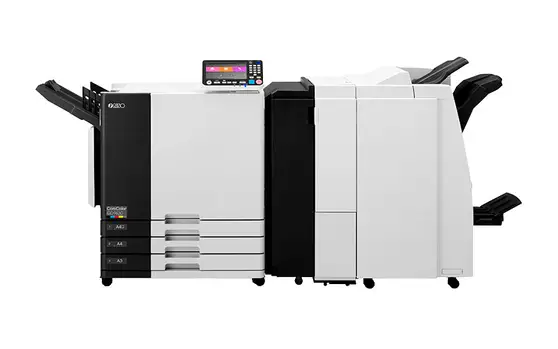

Riso®️ Printer Copiers
Accelerate your print and mail process with dependable high-speed inkjet printing. Versus laser printers, there is no printer downtime or waiting for paper to cool, even for high-volume jobs, so you can process pages immediately through your mail-finishing equipment. That’s why Pitney Bowes partnered with RISO - introducing ComColor® inkjet printer copiers. These world-class solutions improve the productivity of your print while also making your end-to-end mailing process faster and more efficient. Control print budgets with reduced colour printing costs, optimised ink usage and power schedule modes.
Reduce interruptions in your mailing process.



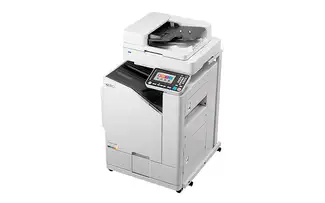
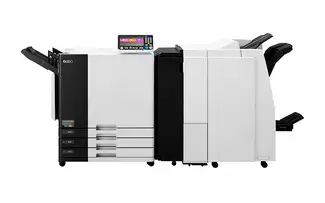
RISO ComColor FW vs GD series
Both ComColor series use heatless FORCEJET inkjet printing for fast, reliable high-volume output that feeds straight into your mail-finishing process. Choose the FW series for fast, dependable transactional volume, or the GD series for production-grade speed and wider colour control.
| ComColor FW Transactional volume | ComColor GD Production-grade | |
|---|---|---|
| Print speed | Up to 120 ppm | Up to 160 ppm |
| Colour | CMYK | CMYKG — adds Gray for a wider tonal range |
| Best for | Fast, reliable transactional and high-volume print runs | Production colour with the highest throughput |
| Advanced colour management | — | Optional FS2000C Fiery® RIP |
| Shared across both | Heatless FORCEJET inkjet · oil-based pigment ink · duty cycle up to 500,000 pages per month | |
Print speeds are simplex, A4 long-edge feed, and vary by model and configuration. Full specifications are available in the FW and GD series brochures.
Riso ComColor Inkjet Printer Copier FAQ
What is a Riso ComColor inkjet printer copier?
The Riso ComColor is a high-speed inkjet printer copier designed for high-volume business printing, particularly print-to-mail. It uses heatless FORCEJET inkjet technology and oil-based pigment ink to print pages cold and flat, so they can feed straight into folding and inserting equipment without the cooling delays or paper curl associated with laser printers. Pitney Bowes supplies the ComColor range in the UK across two series: the FW and the GD.
What's the difference between the Riso ComColor FW and GD series?
The FW series prints up to 120 pages per minute using CMYK ink and suits high-volume office and transactional printing. The GD series is the higher-performance production line: it prints up to 160 pages per minute, adds Gray ink to the colour set (CMYKG) for a wider tonal range, and can be paired with an optional Fiery RIP for advanced colour management and job previewing. In short, choose FW for fast, reliable transactional volume and GD for production-grade speed and colour control.
How fast does the Riso ComColor print?
Print speed depends on the model. In the FW series, the FW5000 reaches up to 90ppm and the FW5230 and FW5231 reach up to 120ppm. In the GD series, the GD7330 reaches up to 130ppm and the top-of-range GD9630 reaches up to 160ppm (A4, long-edge feed, simplex). Inkjet technology means these speeds hold for colour and duplex printing without slowing down.
Is inkjet good enough for high-volume business printing?
Yes. Both ComColor series are rated for a duty cycle of up to 500,000 pages per month and use oil-based pigment ink that prints dry, and is fade- and water-resistant. Because the process is heatless, there's no waiting for pages to cool and no static or curl, which reduces jams and downtime during long runs — often making inkjet more reliable than laser for continuous high-volume work.
Why does heatless printing matter for mailrooms?
Laser printers use heat, which makes paper curl and hold static, so pages often need to cool before they can be folded and inserted. The ComColor prints cold and flat with a straight paper path, so output can move directly into folding and inserting equipment. For print-to-mail operations, that removes a bottleneck and keeps the whole process running continuously.
Can the Riso ComColor scan and copy as well as print?
es, with the optional HS7000 scanner the ComColor functions as a printer copier — scanning and copying duplex originals at up to 100 pages per minute, with output to formats including PDF, TIFF, JPEG and PDF/A. A range of finishing options is also available, including stapling, hole-punching, folding and booklet-making.
You might also like these products.